



The right corporate catering doesn’t just depend on what people want to eat. It depends on how many people you’re trying to feed, how much time they have and what they’re there to do.
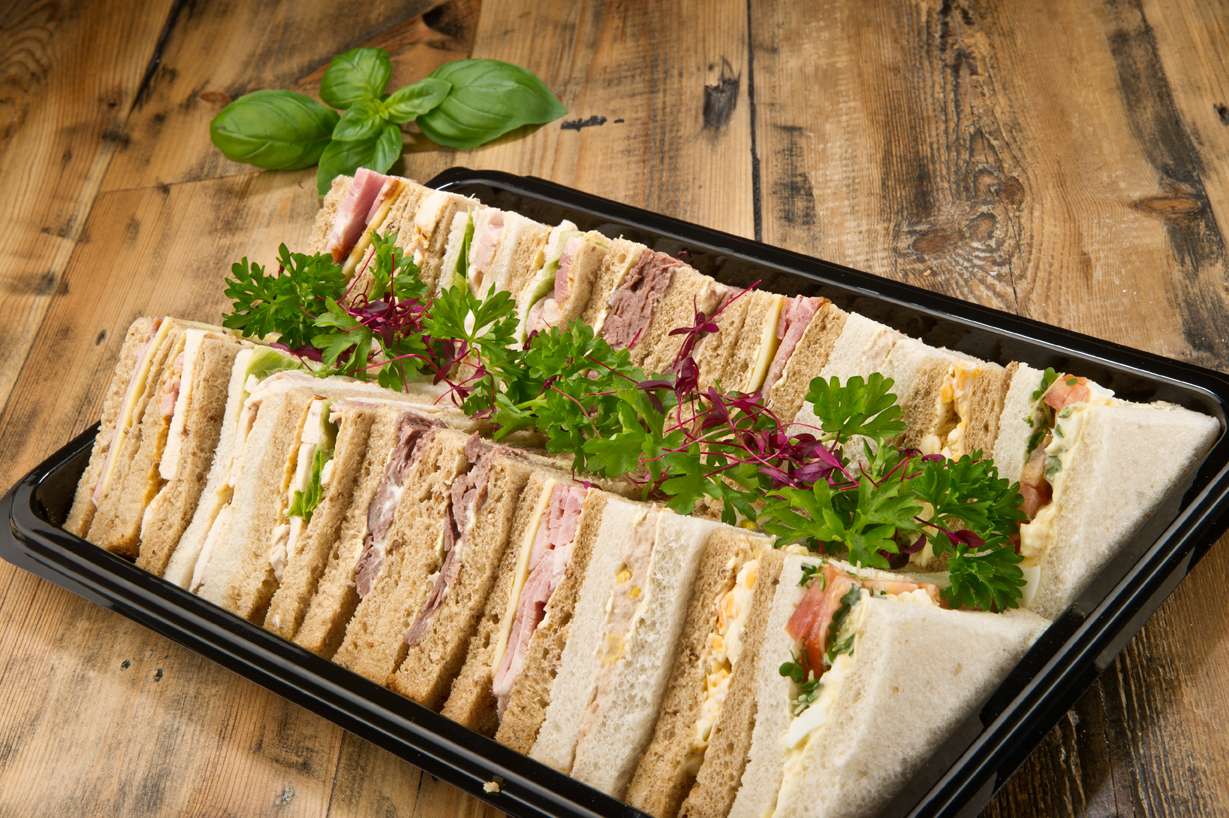
For 10 to 20 people, a professionally prepared selection of sandwiches, rolls, wraps or other easy-to-eat buffet food, with vegetarian, vegan and other required dietary options, will usually work well for a business meeting. For around 50 people, choose a varied cold buffet or similar self-service catering that can be laid out across more than one serving area, allowing everyone to get their food quickly. For 100 people or more, catering needs to be planned as part of the event logistics, with sufficient serving points, clearly identified dietary options and food that can be served efficiently to a large number of guests. These are useful starting points, but the best choice will also depend on the length and type of event, the time of day, the venue and whether the food is intended as a full meal or light refreshments.
Organising lunch for ten people in a meeting room is relatively straightforward. Organising lunch for 100 people who all emerge from a conference at exactly the same time is a very different proposition.
This is one of the most important things to consider when arranging corporate catering. As the number of guests increases, simply ordering more of the same food isn’t always the best solution. The way people are served, how quickly they can access the food, how much space is available and even where everything is positioned start to matter just as much as the menu itself.
For businesses arranging meetings, training days and corporate events across Manchester and Liverpool, getting this right doesn’t need to be complicated. The starting point is understanding how the size and format of your event changes what you need from the catering.
Catering for Around 10 People
For around 10 people, simple meeting catering with two or three savoury choices, suitable dietary alternatives and drinks is normally sufficient. At this size, food can usually be served directly in the meeting room and a formal buffet setup is rarely necessary.
Smaller meetings give you the greatest flexibility. A selection of sandwiches, rolls or other easy-to-eat lunch options works particularly well because guests can help themselves without the meeting having to stop completely.
This is also a size where individual preferences are relatively easy to accommodate. If two people are vegetarian or somebody has a particular dietary requirement, those needs can be identified beforehand and incorporated into the order.
The biggest mistake with smaller meetings is often overcomplicating them. Ten people rarely need an enormous buffet. What matters more is having enough variety, sensible portions and food that can be eaten comfortably in the environment you’re using.
Presentation also becomes particularly noticeable at this scale. In a boardroom or client meeting, the catering is sitting only a few feet away from everyone attending. Neatly presented food creates a very different impression from a collection of supermarket packets placed in the middle of the table.
Catering for Around 20 People
For 20 people, a varied self-service business lunch or cold buffet is usually the most practical choice, with enough choice to accommodate different tastes and dietary requirements. A separate table for the catering is preferable if space allows.
Once the guest list reaches around 20, catering starts to require a little more thought.
You are still dealing with a relatively small group, but there are now enough people for queues and bottlenecks to develop if everything is placed in one small area. Rather than simply putting lunch on the meeting table, it can be better to create a separate serving area where people can move around comfortably.
Variety also becomes more important. With ten guests, two or three choices may be perfectly adequate. With twenty, you’re dealing with a broader range of tastes and are increasingly likely to have several dietary requirements to accommodate.
This is also the point where ordering accurately begins to matter more. Buying individually from shops becomes increasingly inconvenient and estimating quantities by eye can easily result in either too much food or not quite enough.
For training sessions, team meetings and workshops of this size, professional business catering starts to earn its keep through convenience as much as the food itself. Everything arrives together, at the agreed time, leaving the organiser free to concentrate on the event.
Catering for Around 50 People
For around 50 people, buffet-style corporate catering designed for quick self-service is generally the most practical option. Food should be easy to pick up and eat, dietary choices should be clearly identifiable and, where possible, the catering should be arranged so that guests can access it from several points rather than forming one long queue.
At 50 people, catering becomes part of the logistics of the day.
Imagine a training event where the morning session finishes at 12.30pm and the afternoon begins at 1.15pm. You have 45 minutes to feed 50 people, allow them to take a break and get everyone back into the room.
Suddenly, the layout matters enormously.
If all 50 people have to approach the same table from one direction, valuable minutes disappear in a queue. If food and drinks are spread sensibly across the available space, people can help themselves much more quickly.
The menu should reflect this too. Corporate events generally benefit from food that is easy to select, easy to carry and straightforward to eat. This isn’t necessarily the occasion for anything that requires complicated serving or leaves guests trying to balance multiple plates, cutlery and drinks while talking to colleagues.
Dietary requirements need more deliberate planning as numbers increase. At 50 guests, there is a good chance you’ll be catering for several different requirements, so identifying and clearly presenting appropriate options becomes essential.
Good corporate catering at this scale should almost disappear into the event. People find lunch easily, everyone gets something suitable and the timetable continues without the organiser having to intervene.
Catering for 100 People or More
For 100 people or more, corporate catering should be planned as part of the event itself rather than simply treated as a food order. Choose food that can be served quickly, use multiple serving points where possible, separate drinks from the main food area and make dietary options easy for guests to identify.
Once you reach 100 guests, the question is no longer simply, “What should we order?”
It becomes, “How are 100 people going to eat this?”
This is where experienced event catering becomes particularly valuable.
If everyone breaks for lunch simultaneously, the serving area needs to cope with a sudden influx of people. Multiple access points may be preferable to one long table. Drinks may work better in a separate area from food. Dietary options need to be easy to identify without guests having to ask staff or search through everything on offer.
Timing becomes critical too. Catering needs to arrive early enough to be ready when required, but not so early that freshness or presentation suffers.
The amount of food also needs to be considered carefully. Even a relatively small overestimate multiplied across 100 guests can produce substantial waste, while under-ordering creates the much worse problem of food running out before everyone has eaten.
At this scale, catering is part of event planning rather than simply an order placed for lunch.
The Type of Event Matters as Much as the Numbers
Guest numbers only tell you part of the story.
Twenty people attending a two-hour morning meeting have very different requirements from twenty people spending an entire day on a training course. Likewise, catering for 100 people at an informal staff celebration is different from providing lunch during a tightly scheduled conference.
Start with the purpose and timetable of the event.
If people are arriving early, breakfast or refreshments may be appropriate. If the event spans lunchtime, more substantial food will usually be expected. For an all-day session, refreshments throughout the day can be just as important as lunch itself.
You should also consider what happens immediately afterwards. A very heavy lunch may not be ideal before an afternoon of presentations, while food that is too light can leave people hungry again before the event finishes.
The best corporate catering fits around the day rather than forcing the day to fit around the catering.
Don’t Forget the People Behind the Numbers
When you’re organising catering for a large group, it’s easy to start thinking entirely in numbers.
Twenty delegates. Fifty lunches. One hundred guests.
But every one of those numbers represents somebody with their own preferences and requirements.
Asking about dietary requirements in advance is one of the simplest ways to make an event feel properly organised. Vegetarian and vegan choices, allergies and other dietary needs should be considered during planning rather than discovered five minutes before lunch.
Importantly, people with dietary requirements shouldn’t feel as though they’ve been given an inferior alternative while everybody else enjoys the main catering. Thoughtful menu planning allows different requirements to be accommodated naturally.
That matters whether you’re feeding ten people or 100.
How Much Food Should You Actually Order?
The amount of corporate catering you should order depends on the number of guests, the time of day, the duration of the event and whether the food is replacing a meal or being served as a refreshment. A lunchtime event will generally require a full portion per confirmed attendee, while breakfast meetings, networking events and events where food is supplementary may require a different approach.
This is where working with an experienced corporate caterer can remove much of the guesswork.
It is tempting to order extra “just in case”, particularly when an event is important. A sensible buffer can be useful, but repeatedly ordering far more than you need quickly becomes expensive and wasteful.
Accurate guest numbers are therefore valuable. Confirm attendance as close to the ordering deadline as practical and make sure the caterer knows how the day is structured.
A 50-person networking event where food is supplementary may require a different quantity from a 50-person lunchtime meeting where everybody expects a full meal.
There isn’t one universal formula because context matters.
The objective isn’t to cover a table with as much food as possible. It is to make sure everyone has enough, everyone has something suitable and unnecessary waste is kept to a minimum.
Corporate Catering for Manchester and Liverpool Businesses
Whether you’re organising corporate catering in Manchester, Liverpool or elsewhere across the North West, the principle remains the same: catering should make the event easier to run.
For a small meeting, that might simply mean having lunch delivered so nobody needs to leave the office.
For 20 people, it could mean providing enough variety for everyone to find something they enjoy.
At 50, the layout and timing become increasingly important.
At 100 or more, catering becomes an integral part of the event logistics.
The numbers may change, but the measure of successful catering doesn’t.
People should be well fed, dietary requirements should be taken care of and the organiser shouldn’t spend lunchtime solving problems.
When that happens, the catering has done exactly what it was there to do.